
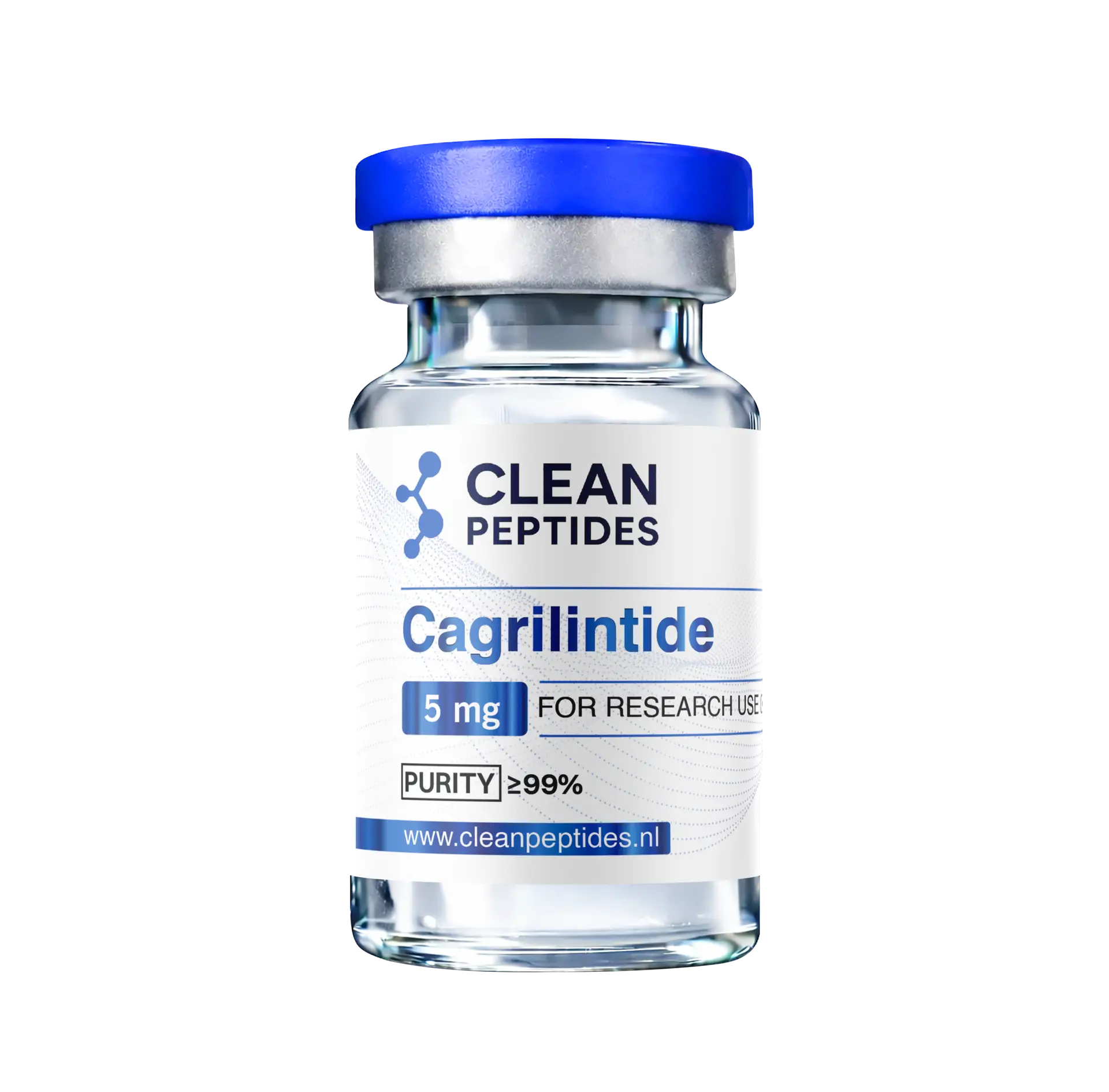

🧪 Cagrilintide 5 mg – Research peptide targeting satiety & appetite signals Cagrilintide is a modern research peptide best known for its influence on satiety signals. Within scientific research, this peptide is being used to better understand how the body processes signals of “enough to eat” and how this is related to energy intake and metabolism. What makes Cagrilintide special is its focus on the amylin receptor. This receptor plays an important role in the feeling of fullness after a meal. This makes Cagrilintide an interesting research object within studies on eating behavior, satiety and weight-related processes.
🔬 Product information at a glance
- Name: Cagrilintide
- Quantity: 5 mg
- Form: Lyophilized powder
- Purity: ≥ 99% (HPLC tested)
- Recipe Focus: Amylin
- CAS number: 2381089-82-1
⚗️ What is Cagrilintide being investigated for? Within research settings, Cagrilintide is widely studied in relation to:
- Sense of satiety and appetite suppression
- Reduced food intake in research models
- The role of amylin within metabolism
- Long-term regulation of eating behavior
🔁 Why is Cagrilintide often investigated along with Retatrutide? Cagrilintide and Retatrutide target different but complementary pathways within metabolism, which together makes them interesting within research:
- Cagrilintide mainly focuses on satiety and being “full” faster
- Retatrutide is being investigated for its broad effects on energy consumption and metabolic processes
In combined research settings, we look at how:
- Saturation (Cagrilintide)
- and metabolic activation (Retatrutide)
can complement each other within a single hormonal approach. It is precisely this combination of mechanisms that makes pairing popular within advanced metabolic research. (Note: this concerns only scientific observations within research context).
📦 Packaging & storage
- Contents: 1 vial of Cagrilintide 5 mg
- Storage: Store cool and dry (2-8 °C), protected from light
🌍 Why choose Cagrilintide 5 mg?
- Focused on satiety and appetite signals
- Interesting as a supplement within broader metabolic research
- High purity and consistent laboratory quality
- Much studied in combination with GLP-1-related peptides
⚠️ Important For research purposes only. Not suitable for human or animal use.
❓ Frequently asked questions How should Cagrilintide 5mg be reconstituted? Reconstitute the lyophilized powder with bacteriostatic or sterile water. Add the water slowly along the vial wall and swirl gently to dissolve; do not shake. How is the purity of this Cagrilintide verified? Every batch is HPLC-tested to confirm a purity of ≥99%. How should the vial be stored? Store the vial in a cool, dry place between 2-8 °C, protected from light, and use reconstituted solution promptly. What comes included with this product? Each order includes 1 vial of Cagrilintide 5 mg. Which Retatrutide vial is often paired with Cagrilintide in research? Researchers studying combined satiety and metabolic pathways often compare this vial with Retatrutide 15mg, our most-studied Retatrutide vial.
Cagrilintide 5 mg — Reconstitution & Dosage Guide
Reconstitute this 5 mg vial with the supplied 3 mL bacteriostatic water (concentration: 1.67 mg/mL). This is an investigational amylin analogue — titration is mandatory, starting at 0.3 mg weekly and stepping up to a 2.4 mg maintenance dose. A 0.6 mg dose draws to 36 units on a U-100 insulin syringe. Inject subcutaneously once weekly. For full titration schedules, the CagriSema combination protocol and safety information, see our complete Cagrilintide Dosage Guide.


Reviews
There are no reviews yet